The Usual Suspects
Almost 90 percent of the problems I first hear from clients sound the same: “We’re following the playbook, but the numbers just aren’t coming in.” Then come the usual suspects: “The market isn’t ready. I’m not boosting social media. Customers don’t get our message. I don’t have the budget for an influencer.”
And if the brand is bigger, the game gets even louder: marketing blames sales, sales blames distribution, and distribution blames a lack of promotions. The arrow almost always points outward, toward someone else, something else, the market, the channels, or the customer. When it does turn inward, it’s usually only to assign blame without really examining the root cause. Or, we pin it all on a lack of money, investment, or economic instabilities, which are, I must say, separately very valid, but in most cases, there is always a way to work around them.
The real issue is that in both directions, outward or inward, we rarely look in a way that actually serves the goal of product-market fit. Market fit starts with the ideal target and goes backward from there. Once there, it means asking the right questions: Who exactly is the market? What does it need? What isn’t being properly served? And how can we change what we do or what we offer so we fit that gap?
Too often, we move too fast. We rush to patch symptoms instead of pausing to investigate the system. We chase the obvious suspects but skip the deeper questioning that might reveal where the real issue lives. This is where the real gap lies. We fail to identify the real problem (the actual culprit). And just like in any investigation, the culprit is rarely who you first suspect. Figuring it out is where most of the challenges lie and where most of the blind spots hide.
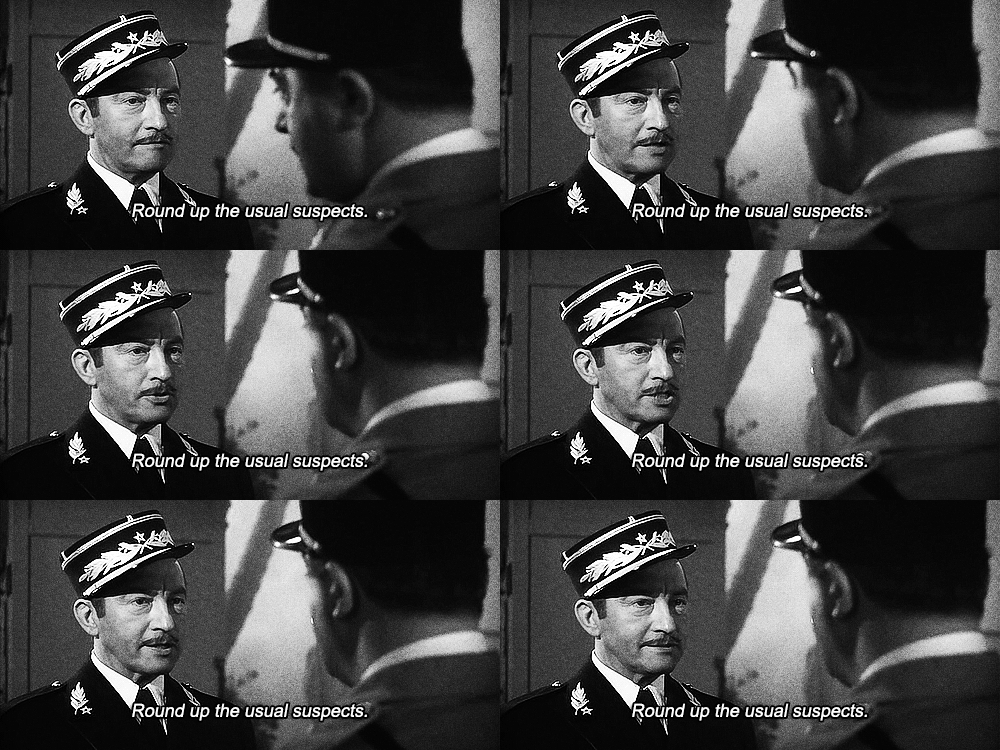
Captain Renault, played by Claude Reins, in the movie Casablanca, directed by Michael Curtiz (1942)
Beyond the Blame Game: A Case from the Field
Back in 2011, I worked on a case with a top soft beverage brand, let’s call it Brand Q. Market share had been dropping for three months straight, enough to show a clear trend. Inside the company, the pattern was predictable: each department was busy defending its own turf instead of stepping back to see the bigger picture. The conversation stayed trapped in circles, and no one was asking the harder questions about what was really happening in the market.

Jeppe Hein, It's Not You It's Me
We rolled up our sleeves and dug in. We went through the sales reports and retail audit data. At first, our attention was on the basics: numeric and weighted distribution, in-store sales execution, merchandising, purchasing volume, shelf-share, the push-and-pull tactics of sales and marketing. But the deeper we went, the clearer it became that the issue wasn’t really about performance. Something else was shifting.
Then one detail in the audit data looked suspicious: the “shelf take-off” was behaving strangely. Customer pick-up for the brand was slipping, specifically within the high weighted distribution. With this clue in hand, it was clear we had to look beyond the numbers. That’s when we stepped outside the spreadsheets and into the field: into stores, into conversations, into observation.
The real picture began to surface. A wave of non-alcoholic beverages was “not so” quietly entering the market. The region we were studying had demographics that didn’t drink much alcohol, but these new products were designed to look like alcoholic ones. That was the hook. Older teenagers and young adults, the core of Brand Q’s target, weren’t drinking alcohol, but they felt cooler holding a sleek non-alcoholic bottle that looked like beer than carrying the “childish-looking” option offered by Brand Q.
It took four weeks of digging, connecting dots, and challenging assumptions before the story became clear. The problem wasn’t sales, or marketing, or distribution weren’t doing their job. It was a shift in consumer behavior that nobody inside had really seen. Once that clicked, what to do next, and where to focus, became obvious.
The Problem with the Problem Is Defining It
Defining the problem is everything. Once the problem is clear, the focus becomes clear. You know what matters, what doesn’t, and what you can finally let go of. Without that step, you end up chasing shadows, adding more noise, piling on more work while still missing the point.
Einstein once said, “I would spend 55 minutes defining the problem and 5 minutes solving it.”
And that says it all. The hardest part isn’t solving, it’s putting the finger where it truly hurts and naming the problem for what it really is. That takes reflection, mapping, and feeding the process with the right data, information, and insights.
Only then can you strip away the distractions and zero in on what deserves your energy. Because once the problem is defined, focus is no longer a guessing game. It’s a choice to let everything else fall away and put your time, effort, and resources where they truly count. Most of the time, we just over-complicate the investigation, only to realize the problem is as simple as Sherlock Holmes finally noticing he's out of dip for the party.
