My First Lesson on Focus
In mid-2012, I left the corporate world and decided to venture out on my own. True, it was within partnerships and collaborations, but with the freedom to shape things my way. By the end of that year, I was introduced to an American mentor who walked me through my debut into what we all call “entrepreneurship” (well, that would be another topic for another day).
At the time, I was juggling two different startups: one related to market research and consultancy, and the other to a production and distribution company for a niche selection of products (we named it Milkkarton), starting with an Italian sparkling wine in a can and a tea brand I was developing with partners.
Each session with my mentor revolved around what was happening in both ventures, as we worked through solutions together. Until one day, he hit me with a question I wasn’t expecting:
“Do you have any preference for these projects? Would you consider dropping one to completely focus on the other?”
I said no, I wanted to do both.
He looked at me, and with a sigh, he said:
“You know, there’s a saying: if you try to catch two rabbits, you’ll catch neither.”
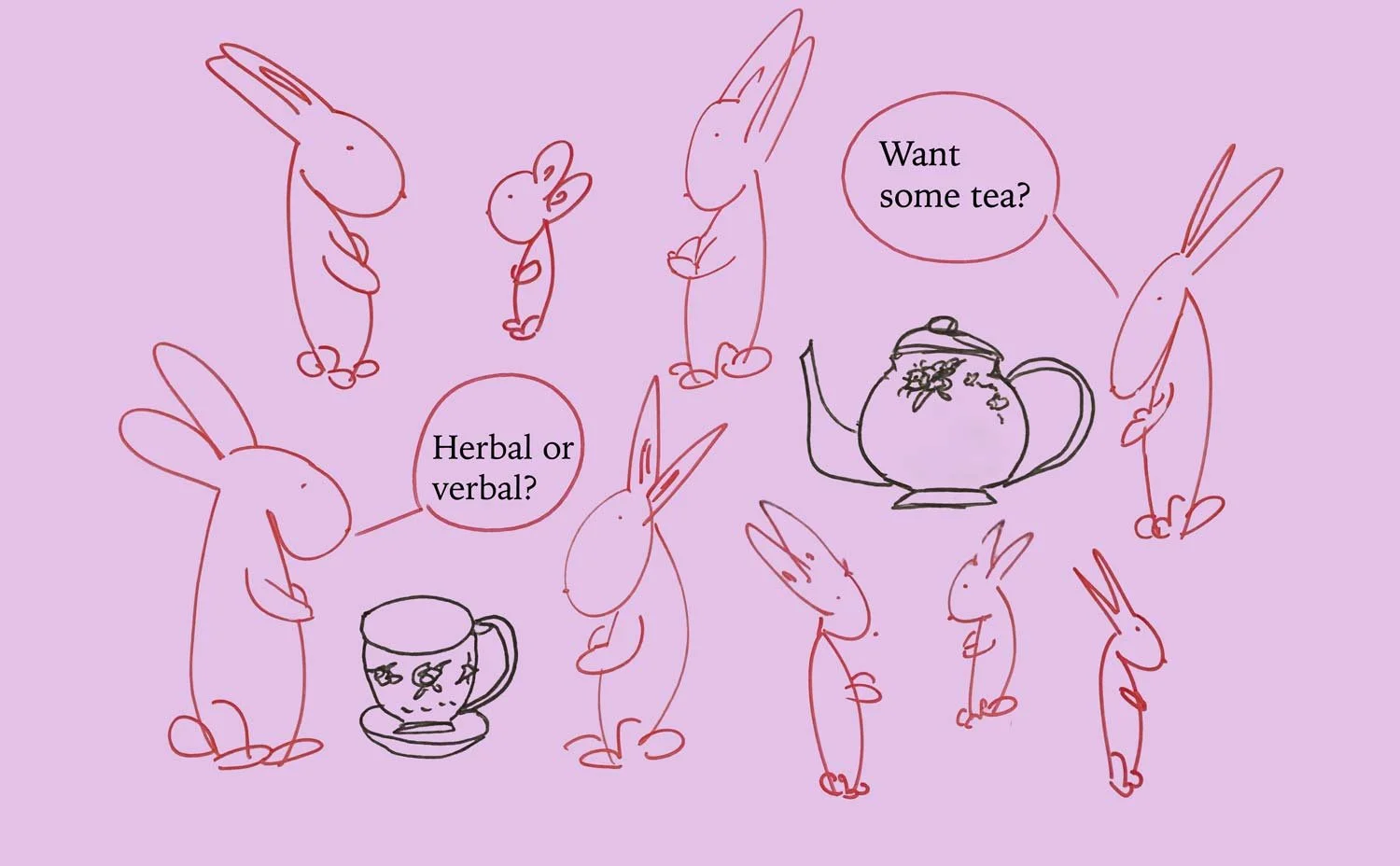
Rabbit, by Sarah Ghanimeh
I wasn’t ready to hear that, that day. But then, this doesn’t just apply to our professional work,
look at us, how we juggle our day-to-day life.
We want to take courses and excel at work.
Do weight training. Pilates.
Go out with friends. Meet new people.
Be at the opening of the newest place in town.
Learn about AI.
Watch the latest series.
Then add: learn to draw. Learn woodworking.
Adopt a pet.
Sign the kids up for every possible activity.
Start a new book. Plan that trip.
Write down what we are grateful for. Be mindful.
And while doing all this, we’re also trying to keep up with every piece of news happening in the world right now.
Not to mention what on earth has been happening every single day over the past few years (well, that’s a whole other endless topic).
And what happens?
We either do nothing.
Or we do everything half-heartedly, haunted by the feeling we’re missing out on what we’re not doing, or not doing enough.
And this isn’t just personal; it’s the condition of our times. We live in a noisy, information-saturated world, one that only grows more crowded by the minute. In the process, the world drifts further away from focusing on what really matters. Without intentional effort, we all risk being pulled in a thousand directions. And as the saying goes, those who commit to nothing end up distracted by everything. And so, the real challenge, and the real opportunity, is learning how to find focus in a distracting world.
When More Means Less: The Case for Strategic Focus
This is where it comes full circle in my work.
In almost every client project, the challenge is the same: figuring out the strategic focus.
So, what does that really mean?
It’s the conscious decision to choose what matters most, and cut the rest.
Because no matter the size- big or small, new or established, local, regional, or multinational- companies and teams often fall into the same traps: chasing new opportunities, adding more products, serving endless client segments, or expanding simply because expansion feels like progress.
But real growth doesn’t come from piling on. It comes from subtraction. From saying no. From focus.
And making that choice requires courage.

Estelle Getty as Sophia Petrillo, The Golden Girls (1985–1992)
Strategic focus means looking at the full picture: the challenges, the strengths, the opportunities, the endless ideas, and the long list of goals, and still choosing to commit to one or two priorities.
Of course, that’s easier said than done. The difficulty isn’t in agreeing that focus matters, but knowing what to prioritize and what to let go. It’s a subtle intersection of reading insights well, drawing on experience, knowing when to follow vision and gut instinct, and then translating all of that into strategies that actually work.
Strategic focus is discipline. It’s the courage to say: we could do everything, but we choose to do what matters most.
It’s the difference between running in circles and moving forward with intent. Because when you try to chase everything at once, you end up with nothing that really matters. Focus is about deciding which “rabbit” is worth running after, and letting the others go.
